La République du Centre
From Gâtinais comes the light
La République du Centre – 26 January 2020
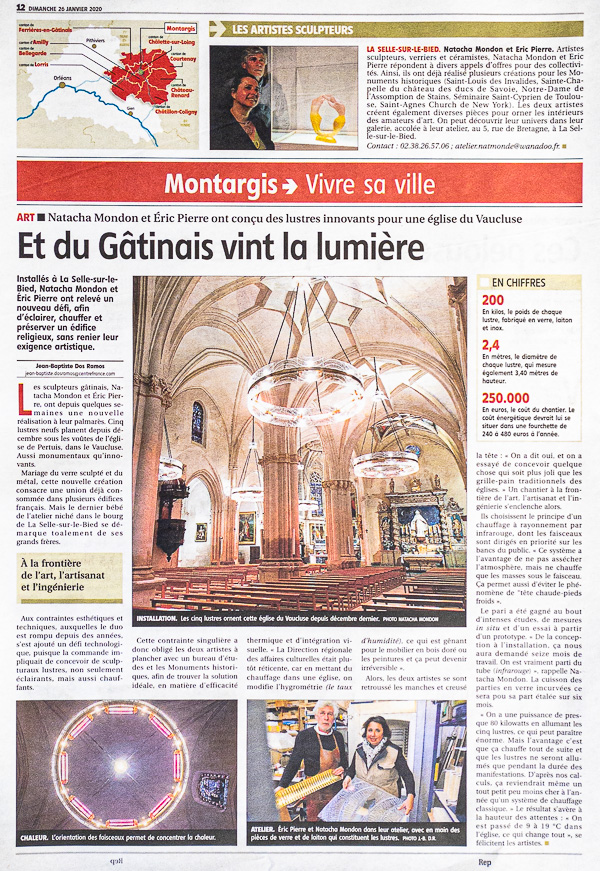
Natacha Mondon and Éric Pierre have designed innovative chandeliers for a church in the Vaucluse
Based in La Selle-sur-le-Bied, Natacha Mondon and Éric Pierre have taken on a new challenge, to light, heat and preserve a religious building, without giving up their artistic standards.
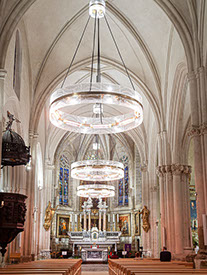
The Gâtinais sculptors have for a few weeks had a new project on their list of achievements. Five new chandeliers have hovered since December under the vaults of the church in Pertuis, in the Vaucluse. As monumental as they are innovative.
A marriage of sculpted glass and metal, this new creation consecrates a union already established in several French buildings. But the latest creation from the studio in the small town of La Selle-sur-le-Bied stands out from its older counterparts.
At the frontier of art, craft and engineering
In addition to the aesthetic and technical constraints the duo has been used to for years, a technological challenge was added: the commission required sculpted chandeliers that would not only light but also heat.
This unusual constraint forced the two artists to work with an engineering office and the Historic Monuments authority to find the ideal solution in terms of thermal efficiency and visual integration. “The Regional Directorate of Cultural Affairs was rather reluctant, because adding heating in a church modifies the hygrometry (humidity), which is problematic for gilded wood furniture or paintings and can become irreversible.”
So the two artists rolled up their sleeves: “We said yes, and tried to design something more beautiful than the traditional toasters of churches.” A project at the frontier of art, craft and engineering then began.
They chose the principle of infrared radiant heating, with beams directed primarily at the public benches. “This system has the advantage of not drying out the atmosphere, but only heats the masses under the beam. It also avoids the ‘hot head — cold feet’ phenomenon.”
The bet was won after intense in-situ measurement studies and a prototype trial. “From design to installation, it took us sixteen months of work. We really started from the infrared tube,” recalls Natacha Mondon. The firing of the curved glass parts alone spanned six months.
“We have a power of nearly 80 kilowatts when lighting the five chandeliers, which may seem enormous. But the advantage is that it heats up immediately and the chandeliers will only be lit for the duration of events. According to our calculations, it would even cost slightly less per year than a conventional heating system.” The result lives up to expectations: “We went from 9 to 19 °C in the church, which changes everything,” the artists rejoice.
— © Jean-Baptiste Dos Ramos, La République du Centre 26/01/2020